Send a Business Proposal While the Buyer Still Remembers You
The quote was easy. The proposal is the part that sits on your desk for four days while the customer waits and slowly goes off the idea.
Quick answer
A proposal is not a price list. It is proof that you understood the job, with the price attached.
Six parts cover almost every one: their problem in their words, what you will do, what it costs, how long it takes, what you need from them, and what happens next.
Write the first two paragraphs about them and the rest about the work. Most proposals do the opposite.
Speed beats polish. A good proposal today wins more work than a beautiful one next week.
Ask most owners why a job was lost and you will hear something about price. Ask the customer and you will often hear something else. They went with the one who replied first, or the one who clearly understood what they asked for, or the only one who explained what happens after they say yes.
The proposal is where all three of those are decided, and it is usually the document nobody has time to do properly.
Why Proposals Take Four Days
Not because writing is hard. Because every proposal starts from a blank page, or worse, from the last one sent to a different customer with the names changed and one paragraph that still mentions them.
So the job sits there. You need an uninterrupted hour, the hour does not arrive, and the customer who called on Monday is being quoted by somebody else on Wednesday.
The fix is not working faster. It is having the pieces already written, so the only new work is the part that is actually about this customer.
What a Proposal Has to Do
Three things, and a price list does none of them.
It has to prove you listened. Specifically, in their words, about their situation. This is the part that gets skipped and it is the part that wins the job.
It has to make saying yes easy. That means no open questions left at the end. What it costs, when it starts, what you need from them, what happens if something changes.
And it has to be easy to forward. The person who called you is often not the only person deciding. A proposal that only makes sense if you explain it over the phone will not survive being sent to somebody else.
The Six Parts
Keep this list beside you and almost nothing goes missing.
Their problem, in their words. Two or three sentences. Use the phrases they actually used on the call. This is the only part a competitor cannot copy.
What you will do. The work itself, in plain terms, in the order it happens. Not a list of your capabilities.
What it costs. One number if you can. If there are options, three at most, with a clear recommendation.
How long it takes. A start, a finish, and an honest note about anything that could move it.
What you need from them. Access, a decision, a deposit, somebody to be on site. Say it now, not in week two.
What happens next. One instruction. Reply to this email, sign here, call me. One.
Write the First Two Paragraphs About Them
Open most proposals and the first page is a history of the company sending it. Established in 1998. A team of dedicated professionals. Committed to quality.
The customer is not reading for that. They are reading to find out whether you understood the thing they are worried about.
So the first two paragraphs are theirs. The problem as they described it, what they said matters most, and anything they mentioned that a careless reader would have missed. The rest of the document can be about the work. By then they are reading properly.
Price So the Answer Is Yes or No
A price that invites a conversation gets a conversation, and conversations take weeks.
Put the number where it can be found in five seconds. If you offer options, three is the limit and one of them should be marked as the one you recommend, with a sentence saying why. Without that sentence, options become homework, and homework gets postponed.
State what is not included too. Not as a disclaimer buried at the bottom, but as a short honest line in the middle. The proposals that cause arguments later are almost always the ones that were vague here to avoid an awkward moment.
Build It From What You Already Have
Nearly everything a proposal needs already exists somewhere in your business. The call where they explained the problem. The last three proposals you sent for similar work. The page on your site that describes the service. Your price list. The email where they listed their requirements.
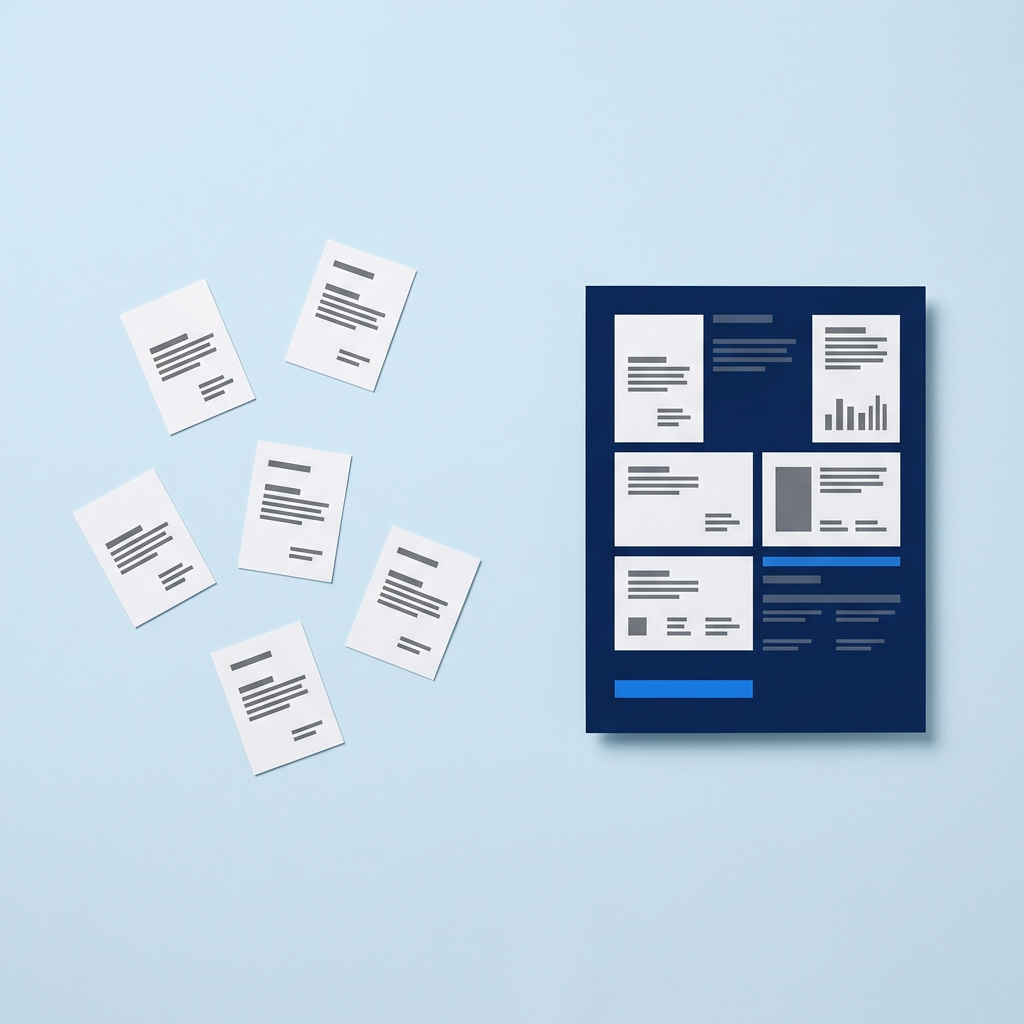
A lab in IdeoLab is a canvas where that source material and the work you produce from it sit side by side as cards. You can bring in a document, a web page, a recording or a video, and it is available to the chat you are working in. So the recording of the call, the earlier proposal and the service page can all be in front of the same conversation, and the draft comes out of your own material instead of out of nothing.
What that changes in practice is the starting point. Instead of a blank page you have a draft that already uses their words and your prices, and your hour goes on correcting it rather than producing it.
If this is the job that keeps slipping, the trial covers the whole system for a week: https://ideolab.ai/TrialBuild
The same approach works for the pieces around the proposal, the follow up note, the summary for whoever else is deciding, and the one page version for the customer who will not read four pages. Once your real material is in one place, each of those is a small job rather than another blank page. The repeating parts of this are worth turning into a routine, which is covered in getting back the hour you lose every morning.
Send It While They Still Remember Calling You
There is a window, and it is shorter than most owners think. The day they called, they were motivated. A week later the problem has become normal again.
Decide a rule and hold it. Same day for anything small, forty eight hours for anything that needs real thought. If you cannot meet that, send the short version now and say the detailed one follows, because a short proposal today keeps you in the running and a perfect one next week often does not.
What to Do When They Go Quiet
Silence is not a no, and it is usually not about you. The person has a job and your proposal is sitting under it.
Follow up twice, with a gap, and make each one useful. Not a nudge asking whether they saw it. Something short that answers the question they are probably stuck on, or a note that the start date you held is about to move.
Then stop and write down what happened. The proposals that go quiet are your best material, because the pattern in them tells you which part of the document is not doing its job. If you are not sure what that pattern is, the words customers use about you are a good place to look, which is what the words that sell your business is about.
Start With the One You Send Most
Do not build a proposal system. Take the job you quote most often, write the five parts that never change, and keep them where you can reach them.
The next time somebody calls about that job, the only thing you are writing is the part about them, and that proposal goes out the same day.
Start your free 7 day trial of IdeoLab →
Most people start on the trial, which is full Agency access for seven days. If you already know which plan fits, you can start on one directly. Starter is $39 a month with 2,500 credits for one person, and Agency is $99 a month with 10,000 credits for a team.
Questions Owners Ask About Business Proposals
How long should a proposal be?
Two pages for most work. Long enough to answer the obvious questions, short enough that the person deciding reads all of it. If it runs to eight, the extra six are usually about you rather than about the job.
Should I send a price before they have agreed to the approach?
Yes, in the same document. Separating them gives the customer two decisions to make and doubles the time it takes. State the approach, then the price for it.
What about jobs where I genuinely cannot give one number?
Give a range with the two things that decide where it lands, and say how quickly you can turn the range into a number. Vagueness is only a problem when it is unexplained.
Do proposals need design work?
Clean and readable is enough. A well organised document in plain type beats a designed one that buries the price on page five. Spend the time on the first two paragraphs instead.
How many follow ups before I let it go?
Two, spaced out, each with something useful in it. After that, move it to a list you revisit in a few months. Jobs that went quiet often come back when the problem gets worse.
Should the proposal mention other customers I have worked with?
One short, relevant example helps, especially if their situation was similar. A page of logos does not. The test is whether the reader learns something about their own job from it.